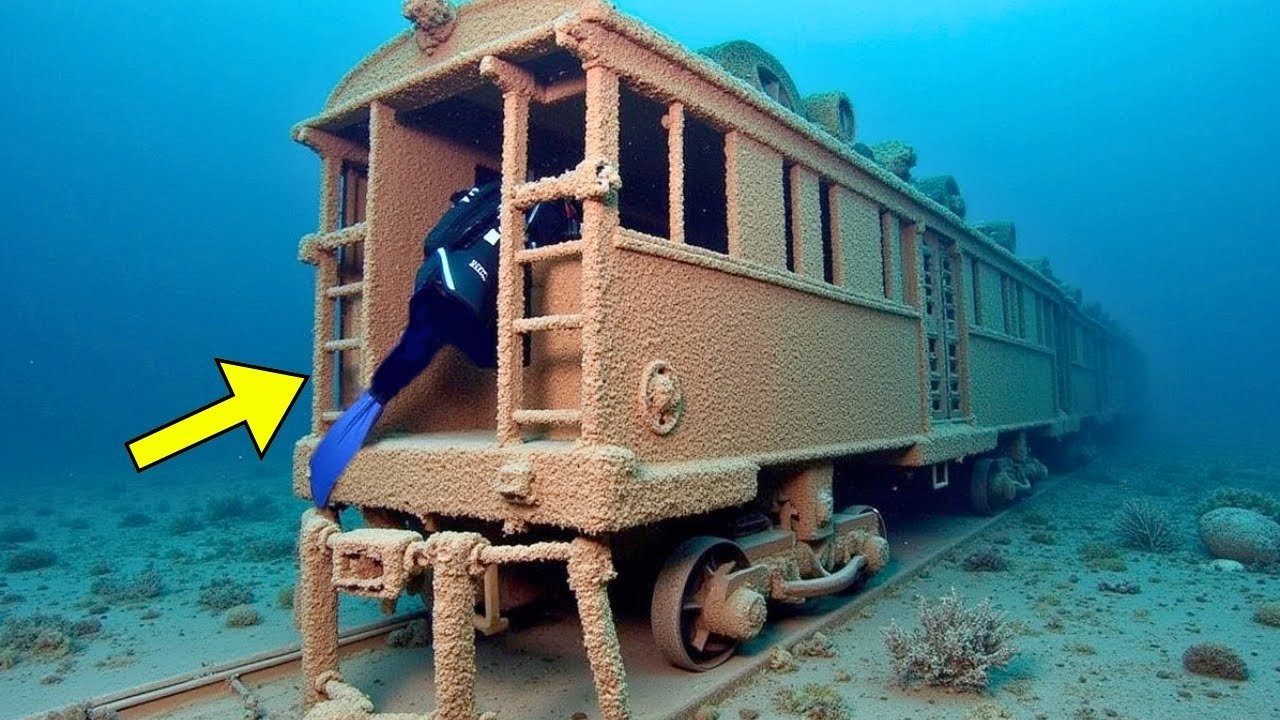
During a routine underwater seafloor scanning, experienced diver and sonar specialist Matt noticed a strange object on the screen. A long, rectangular structure stood out against the ocean floor, completely unlike any natural formation. When the image became clearer, there was no doubt—a real railroad car lay at the bottom. The main question arose: how did the train end up so far from land and railroad tracks?
Eager to understand what was happening, Matt donned his gear and began his descent. The water grew darker with each meter, and the beam of his flashlight barely pierced the murky green depths. Soon, the silhouette of an old train car appeared before him. The metal was covered in barnacles and seaweed, the wheels were almost hidden under a layer of silt, and the serial number was still visible on the hull. This was no optical illusion or part of a shipwreck—a real train rested on the ocean floor. Once inside, the diver was astonished by what he saw. Most of the seats were still in place, the windows were almost completely intact, and a strange silence reigned inside, as if time had stood still. An old suitcase lay on the floor. Inside were clothes and hermetically sealed documents bearing the date October 12, 1962. It was as if someone had planned for the car to remain underwater for a long time.
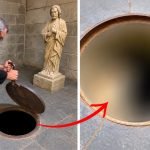
Examining the far part of the car, Matt noticed a hidden hatch, concealed under the floor between the rows of seats. His air supply was rapidly dwindling, but curiosity overcame his fear. Opening the hatch, he discovered a passage below the seafloor—where even sonar couldn’t see.
What lay below completely changed his perception of the discovery.
Behind the hidden passage was a room resembling a scientific complex. Inside were neatly hung diving suits with the staff’s names, metal lockers containing research materials, and documents bearing the seals of the oceanographic institute. It became clear: the train car was no accidental victim of the disaster. It had been deliberately used as a disguised underwater research station.
The name of the project manager, Walter Tewson, appeared most frequently in the reports.
Returning to the surface, Matt carefully examined the observation log he had found. The entries indicated that a group of scientists had been studying deep-sea heat flows. During the experiments, a serious structural failure occurred, and water began flooding the train car rapidly.
Trapped underwater and with oxygen rapidly running out, the team was forced to abandon the station urgently. The scientists reached the surface with virtually no equipment, using makeshift buoyancy aids.
A subsequent investigation confirmed the incredible story: Walter Tewson and his entire team had survived. Moreover, years later, Matt was able to personally speak with the scientist and learn details of events that had long remained classified.
 Discuss
More news
Discuss
More news