Lindsey thinks she and her family have found the perfect new home — until a strange sound beneath the scullery raises questions no one can answer. Their investigation leads to a hidden metal hatch and an underground space that appears frozen in another era. Inside, forgotten belongings and old documents offer clues to a story dating back to the closing days of World War II. What happened beneath this house, and why was it left undiscovered for so long?
The first clue was a hollow noise coming from the kitchen’s adjoining utility room. After spotting a metal cover concealed beneath a cupboard, Lindsey and her family moved the furniture aside to investigate. At first, she suspected that the opening might lead to a small cellar once used to store wine. Instead, it revealed a deep shaft with a rusty ladder descending into darkness.
The drop was far greater than they had expected, reaching roughly 30 metres underground. Lindsey’s husband, Flint, squeezed through the narrow entrance and began exploring a long, straight passage. Using a walkie-talkie, he kept his wife informed of what he was seeing as he moved farther into the underground structure. A faint light could be seen in the distance, suggesting that the passage continued beyond the first section.
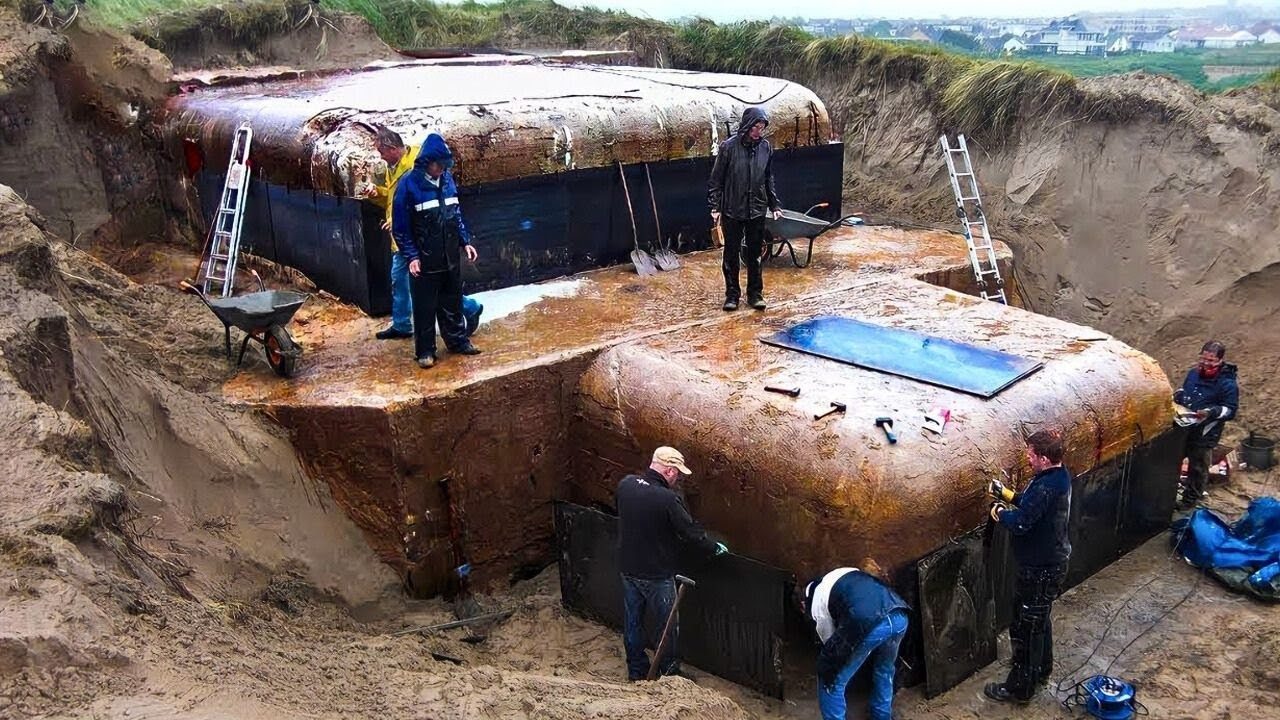
The discovery became even more intriguing when the family noticed a small concrete projection in the lawn above. Below ground, Flint had encountered a heavy iron door that he could not open by himself. Lindsey and her brother joined him, and the three worked together to force the stubborn barrier apart. After a tremendous bang, the door finally gave way.
Beyond it stood a room packed with old bottles and jars. Their labels revealed that some contained whisky and rum produced in 1945. The family was astonished to find drinks that had remained hidden for decades, apparently untouched since the end of the war.
Yet the bottles were only the beginning. Continuing through the bunker, Lindsey, Flint, and her brother discovered a large suitcase containing a military report dated 1945. The documents reportedly listed submarines belonging to the Allied navies. Their historical significance was immediately apparent, although the precise circumstances in which the papers had been abandoned remained unclear. The family could only speculate about how the bunker had been used and why its contents had been left behind.
Further exploration revealed additional rooms, each containing objects that offered glimpses into the past. Around 20 metres from one of their earlier discoveries, they came across another chamber that inspired plans for a new project. Even a surviving cupboard appeared remarkably well preserved, as though it had been left behind only recently.
Lindsey and her relatives eventually began restoring parts of the underground complex, attempting to recreate its original appearance while preserving the objects they had found. What started as a mysterious feature beneath their property had become a much larger undertaking, combining historical preservation with the challenge of understanding the site’s forgotten purpose.
The family’s discovery has since taken on a life of its own. Rather than keeping the bunker hidden from view, they have worked to share its unusual history with visitors. The site has become a museum attraction, drawing large crowds and giving people an opportunity to explore a place that might otherwise have remained concealed beneath the ground.
For Lindsey, the most remarkable part of the experience is how an ordinary renovation mystery led to an encounter with the past. The bottles, military papers, and preserved furnishings offer tantalizing clues, but they also leave important questions unanswered. And that lingering uncertainty is part of what makes the underground discovery so compelling.
Preserve the one-million visitors detailExplain the museum’s current setting
 Discuss
More news
Discuss
More news