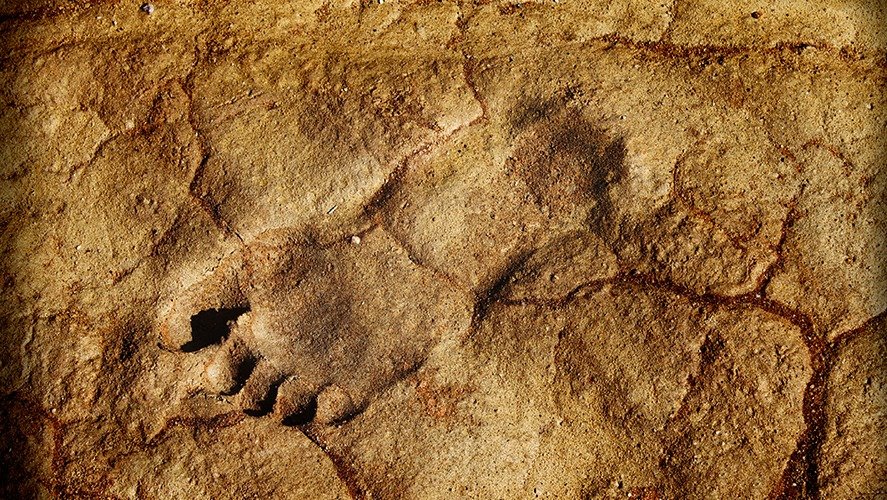
Arizona: It all began with a loud crack echoing through the ancient cliffs of the Grand Canyon. A huge section of the canyon wall suddenly broke off and collapsed right next to one of the most popular hiking trails.
To park staff, it looked like an ordinary rock slide that needed to be cleared. However, among the fresh debris was a stone of great interest to scientists.
Mysterious Footprints on a Fresh Fragment
While hiking along the Bright Angel Trail, Norwegian geologist Allan Krill noticed an unusual boulder. Several rows of repeating diagonal imprints were visible on its surface.
The scientist photographed the find and sent it to paleontologist Stephen Rowland of the University of Nevada. Rowland realized almost immediately that this was more than just another fossilized footprint. The prints turned out to be extremely ancient—estimated at approximately 313 million years old.
This means they date back to the Carboniferous period, long before the appearance of dinosaurs. At that time, terrestrial ecosystems were beginning to develop actively, and the first vertebrates were gradually colonizing land.
A Remarkable Gait
But the real mystery lay not only in the age of the find.
Based on the nature of the prints, researchers were able to reconstruct the animal’s gait patterns. The trackway indicates a so-called lateral gait sequence: the limbs moved alternately on one side of the body, then on the other.
This principle of locomotion is well known to us from modern quadrupeds, including dogs, cats, and horses.
Particularly interesting is that the tracks were left in an ancient sandy environment. Judging by the surrounding rocks, the animal moved across shifting dunes, indicating that vertebrates could have adapted to life on land quite effectively even hundreds of millions of years ago. Who walked across the ancient sand?
It’s impossible to determine the exact animal—virtually nothing remains of the traveler over hundreds of millions of years. However, experts associate the tracks with diadectomorphs—ancient, massive land vertebrates that may have resembled large lizards.
At one point, an unknown creature crossed the wet sand and left behind several footprints. Soon, the tracks were hidden under new layers of sediment and literally vanished from the world for hundreds of millions of years.
Then, a sudden collapse in the Grand Canyon revealed them again.
Today, these footprints allow scientists to peer into the incredibly distant past and better understand how the first vertebrates colonized land long before the appearance of dinosaurs.
 Discuss
More news
Discuss
More news