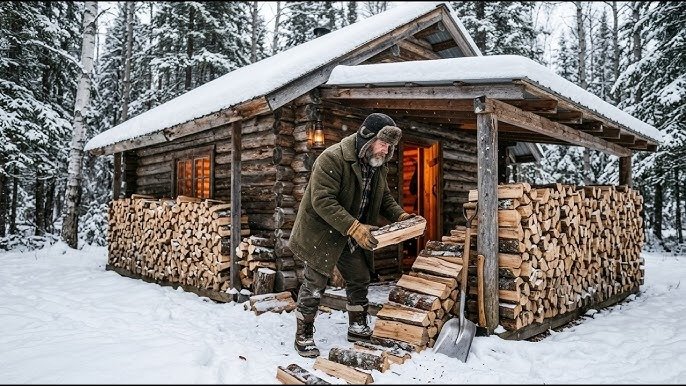
Deep in a winter forest, where snow-covered pines stretched toward a gray sky, farmer Henry Calloway set out to gather firewood, unaware that this day would change his life forever. The crunch of snow beneath his boots broke the oppressive silence, and an icy wind cut through his clothes. The forest seemed endless and alien.
Suddenly, Henry stopped. Ahead, near the bank of a frozen river, something glimmered strangely in the dim winter light. A huge, transparent block of ice towered between the trees. Within it, a dark silhouette could be discerned—something large and frightening, hidden beneath layers of frost.
A sense of unease gripped the man. It seemed as if the forest itself were watching him. He approached closer and cautiously touched the icy surface. The cold was unnatural, almost scalding. Through the murky ice, he could make out the creature’s outline: long limbs, a massive body, and a strangely shaped head. A chill ran down his spine at the sight.
Henry lived alone in an old house on the edge of the forest. After the death of his wife, he had become accustomed to the quiet, measured life: tending the farm, stoking the stove, and whiled away the evenings by the fire. But that morning, everything was different. His supply of firewood was nearly depleted, and an approaching storm promised a harsh night. So he set out into the forest—and stumbled upon a mysterious find.
Curiosity overcame fear. Henry dragged the heavy ice block on a sled to his house. Along the way, he constantly felt as if the creature within the ice was about to stir. The trees creaked in the wind, and every snap of a branch made him turn nervously. When he got home, he covered the ice with a tarp and decided to call the only person he trusted in such matters—his cousin Sophie Clark, an ecologist who studied northern ecosystems.
After hearing Henry’s story, Sophie initially thought he was joking, but she came anyway. When she saw the ice block, her expression changed. She examined the find carefully and noticed that the ice looked very ancient—almost like a real glacier.
“This could be something incredibly old,” she said, running a scanner over the surface. “And possibly very important.”
Sophie contacted her colleagues—glaciologist Dr. Clara Reynolds and paleobiologist Dr. Victor Yates. The very next day, the scientists arrived in Pine Hollow to study the strange object.
They worked for several hours, taking photographs and analyzing the ice’s structure. Gradually, the mystery began to unravel. Victor carefully examined the scan results and finally smiled:
“It looks like we’re dealing with a prehistoric giant sloth. It most likely lived thousands of years ago, during the Pleistocene era.”
Henry couldn’t believe his ears. All this time, he’d thought he’d found an unknown monster, but it turned out to be an ancient animal that had long since disappeared from the face of the Earth.
The news quickly spread across the country. The small town of Pine Hollow suddenly found itself the center of attention for journalists and scientists. The icy find was transported to a special lab, and later, the preserved ancient sloth became the centerpiece of a natural history museum.
For Henry, it all seemed like a dream. He’d gone into the forest to collect firewood and ended up making a discovery that would become known to the entire world.
 Discuss
More news
Discuss
More news