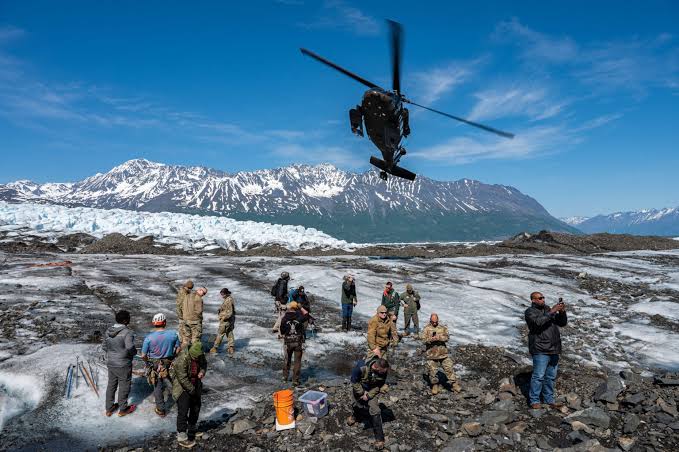
For many, Alaska is the epitome of pristine wilderness: endless glaciers, snow-capped mountains, and frozen landscapes that seem eternal. However, beneath this icy surface, scientists are observing dramatic changes that could reshape the region for decades to come. The greatest threat lies not in what’s visible on the surface, but in what’s happening deep underground.
Much of Alaska lies on permafrost—soil that has remained frozen for thousands of years. For decades, this frozen ground provided a stable foundation for homes, highways, pipelines, and entire communities. Today, however, this foundation is becoming increasingly unstable.
Alaska is warming significantly faster than many other parts of the world. Rising temperatures are leading to longer summers, milder winters, and the gradual thawing of permafrost. As the ice within the soil begins to melt, the ground loses its stability. As a result, roads are deforming, buildings are leaning, and swathes of land are slowly sinking or collapsing.
Researchers have been monitoring these changes for years. Near Fairbanks, a permafrost research tunnel allows scientists to study the frozen ground from the inside. Instruments installed throughout the tunnel measure temperature, humidity, and structural stability. Their observations show that areas once permanently frozen are gradually thawing, confirming concerns that the landscape is becoming less stable with each passing year.
The consequences are already visible throughout Alaska. In many regions where ground ice has melted, circular depressions known as thermokarst features or pockmarks are appearing. These features can develop into sinkholes, capable of damaging roads, buildings, and other critical infrastructure, sometimes with little or no warning.
Thawing permafrost is also revealing surprising discoveries from the distant past. Researchers have discovered the remains of Ice Age animals, including woolly mammoths, preserved in frozen soil for thousands of years. Along with these fossils, scientists identified ancient microorganisms that remained dormant in the ice until it thawed.
Laboratory studies have shown that some of these microorganisms can become active again after thawing. Certain microorganisms naturally produce methane, a greenhouse gas that traps much more heat in the short term than carbon dioxide. As permafrost thaws, increasing amounts of methane can escape into the atmosphere, potentially accelerating climate change and creating a cycle in which warming leads to even greater thaw.
Although the situation is grave, experts believe there is still hope. Protecting northern forests, restoring damaged ecosystems, and reducing greenhouse gas emissions can help slow the rate of warming. These efforts can limit further permafrost degradation and reduce long-term risks to both local communities and the global climate.
 Discuss
More news
Discuss
More news