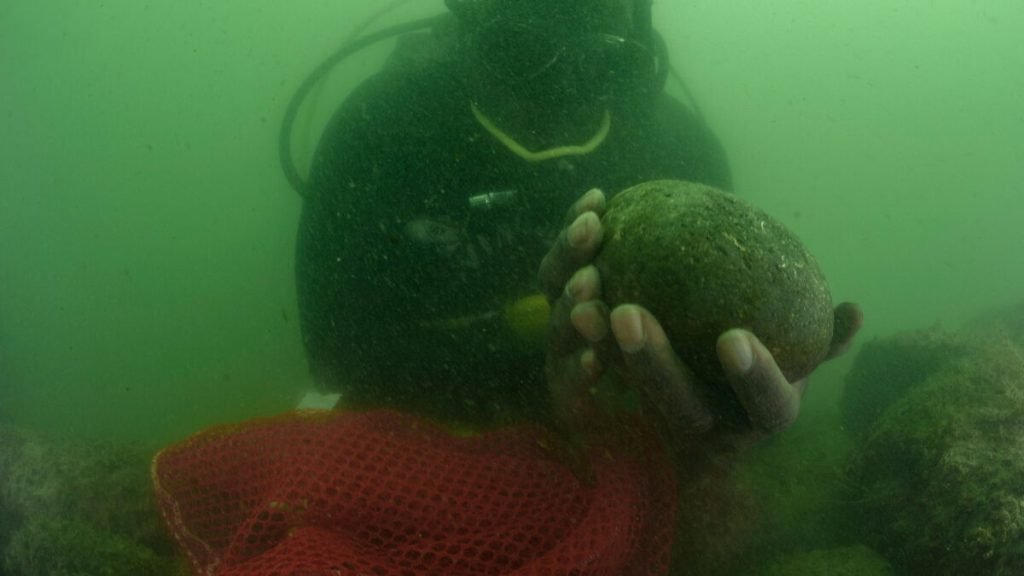
Evan Cole, a professional diver who specialized in underwater search and salvage operations, was expecting a routine workday. Descending into the murky waters of the Marin River near a technical pier, he slowly scanned the silty bottom. The beam of his powerful flashlight swept over submerged objects until it suddenly illuminated something entirely unexpected.
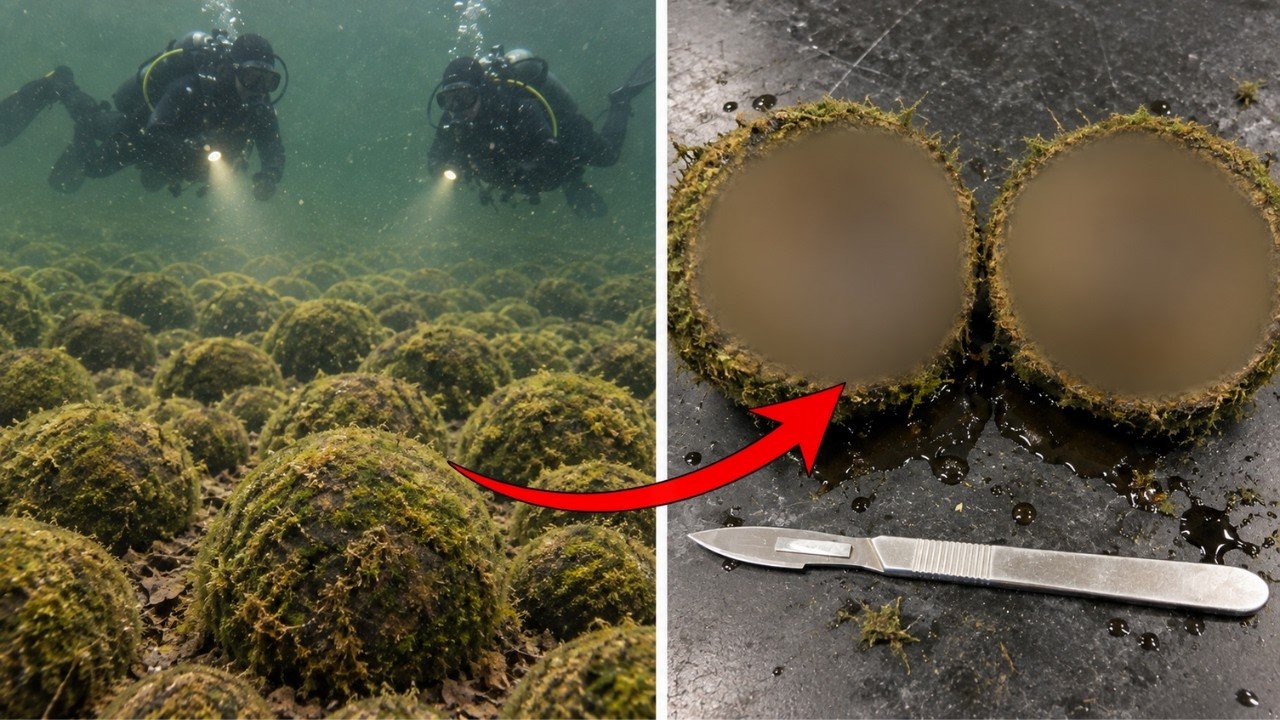
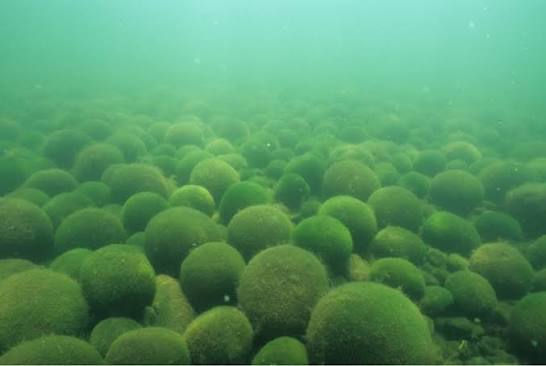
Before him lay hundreds of identical spheres. Each sphere was coated in a thick layer of moss and grime. They were scattered across the riverbed so densely that it looked as if someone had deliberately strewn massive eggs—belonging to some unknown creature—across the bottom.
Evan had never encountered anything like this. He collected a few samples and brought them up to his boat. Back at his workshop by the pier, he placed one of the spheres on his workbench and carefully sliced into its outer shell.
What he found inside immediately put him on high alert. Beneath the fibrous exterior lay a dense mass of living organisms, intermixed with synthetic fibers. This was clearly no ordinary cluster of river vegetation; the strange formations appeared to be intentionally engineered structures, seemingly capable of interacting with their environment.
Evan stopped his work and consulted aquatic ecosystem experts. After an initial assessment, the matter was escalated to federal law enforcement. Before long, the investigation took on an entirely unexpected scale.
According to investigators, the spheres may be linked to Veora Water Systems, a company involved in maintaining municipal infrastructure. The devices were allegedly placed near water intake facilities, where they could trigger dangerous ecosystem disruptions and interfere with equipment operation.
But the most alarming aspect was the potential motive behind this operation. By artificially creating water supply issues, the contractor reportedly aimed to secure multi-million-dollar contracts for emergency repairs. While municipal authorities scrambled to resolve the crisis, the company could step in with pre-prepared solutions—at an exorbitant cost.
According to the account, investigators discovered internal documents during searches that linked the orchestrated water disruptions to the firm’s projected earnings. These materials became part of the investigation, and law enforcement placed the executives under intense scrutiny.
Meanwhile, specialized teams began surveying the river and recovering the suspicious objects. Evan’s timely discovery may well have helped avert serious consequences for the local water supply.
What began as a routine search for scrap metal evolved into an investigation into an alleged conspiracy against an entire city. Yet, a key question remained: how many more such spheres might be lying hidden beneath the river silt, completely unknown to anyone?
 Discuss
More news