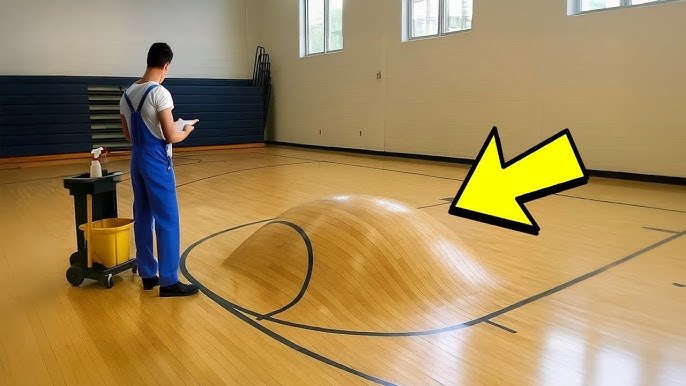
Just the night before, everything in the school gym had been perfectly normal. Over a hundred children had been running around the basketball court, unaware of the danger lurking right beneath them. But early the next morning, custodian Carl Jenkins opened the gym and immediately realized something had changed.
The wooden flooring was no longer level. A massive bulge had appeared in the center of the court, causing the painted basketball lines to curve noticeably. It looked as if something underneath was pushing the floor upward.
At first, Carl assumed water was the culprit. The area had seen heavy downpours over the past few days, so moisture damage seemed like a logical explanation. However, the scale of the deformation was alarming: it wasn’t just a few boards that had lifted, but a large section of the floor.
School administrators immediately closed the gym and canceled classes. An engineer was brought in to investigate what was happening beneath the concrete slab.
A thermal imaging camera detected an unusual temperature zone directly beneath the center of the court. Workers then began carefully opening up the floor. They removed the wood surface, followed by the plywood and a layer of insulation. Beneath them lay a concrete slab, also damaged.
When they cut a hole in the slab, a flashlight beam illuminated a smooth metal object resting below.
But the most alarming part was yet to come.
A pungent odor, resembling a mix of old fuel and wet earth, began wafting from the cavity. The engineer tested the air with a gas analyzer, and the readings spiked sharply. The device triggered an alarm.
Workers immediately shut off their power tools; everyone was evacuated from the building, and emergency responders and hazardous materials specialists were called to the scene.
Once emergency services arrived, they lowered a specialized camera into the opening. The image finally explained what was happening: a massive steel tank lay beneath the gymnasium.
It was an old underground fuel reservoir.
The most surprising discovery came after checking the archives. Old construction blueprints did indeed show a tank that predated the current gym. The documents explicitly stated that it had to be removed before the new construction began.
However, no record confirmed that the tank had actually been removed.
It appears that during the renovation, they left it underground. Concrete was poured over the old structure, the flooring was laid, and a basketball court soon appeared above it. Year after year, children played sports just meters above the forgotten fuel tank.
The question remained: why did it decide to rise right then?
The answer lay in the weather. Prolonged heavy rains and a clogged storm drainage system had left the soil beneath the building heavily saturated with water. The empty—or nearly empty—metal tank gained buoyancy and began to float upward through the waterlogged soil.
The massive tank pressed against the concrete slab from below, cracking it and forcing a section of the floor upward.
However, the danger went beyond structural damage. Residual petroleum products remained inside the tank. As the tank shifted, flammable vapors began to leak out.
That is precisely why just a few minutes of work with an ordinary electric saw could have ended in disaster.
Specialists ventilated the space, removed the remaining fuel, and extracted the old tank. What had looked like a strange bump in the floor that morning turned out to be a warning of a far more serious threat.
And the most chilling part—all that time, the schoolchildren had no idea that a dangerous, forgotten structure lay directly beneath the center of the court.
 Discuss
More news
Discuss
More news