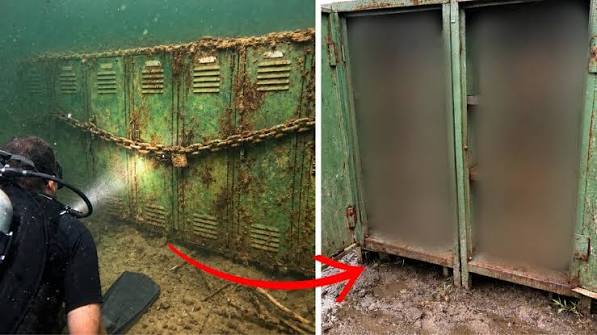
While inspecting an old bridge in a swampy area of Mississippi, professional diver Frank Leary noticed something unusual beneath a thick layer of silt. A long, dark silhouette protruded from the muck. Pushing aside the murky sediment, he uncovered green paint, ventilation slats, and metal handles. Before him lay six old-school lockers, bound together with heavy iron chains—it seemed someone had gone to great lengths to lock them shut.
When the recovery team hauled the find onto the bank, no one expected anything significant; most assumed it was merely scrap metal discarded decades ago. But as soon as the crew cut through the rusted chains and swung open the first door, Frank recoiled sharply. He turned pale and covered his mouth with his hand, barely holding back tears. A sheriff’s deputy standing nearby peered inside, his expression shifting instantly, and he demanded that reinforcements be called immediately.
Inside the lockers, they discovered rows of sealed glass jars containing a murky liquid, along with strange biological specimens and laboratory equipment. The site was immediately designated a potentially hazardous scene, and experts in toxic waste remediation—along with federal authorities—were brought in.
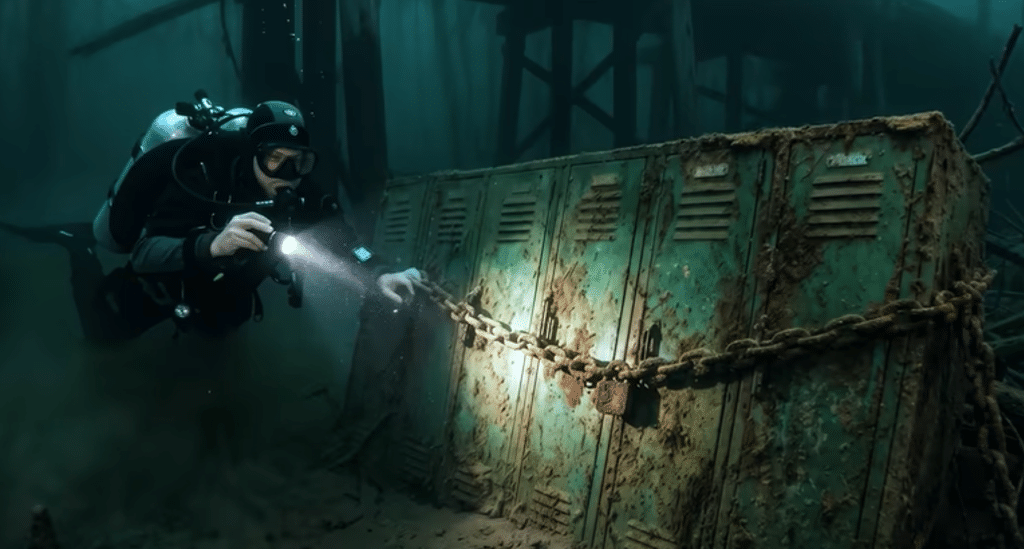
Investigators found their first lead on a worn metal tag. An inventory number traced the items back to Herelmir Medical College. Archival records confirmed that, in 1972, the institution had indeed used these old green lockers to store research materials and delicate laboratory specimens.
However, two years later, the entire collection was supposed to have been removed and destroyed. The contractor was paid several thousand dollars for this job. Rather than opting for expensive, specialized disposal, the foreman chose an illegal method to get rid of the cargo.
According to investigators, the workers turned onto an abandoned road near the river in the dead of night, dumped the lockers into the swampy water, and pocketed the money. And so, the hazardous cargo remained buried under the silt for decades—all but forgotten—until a severe flood altered the river’s course and exposed the metallic discovery.
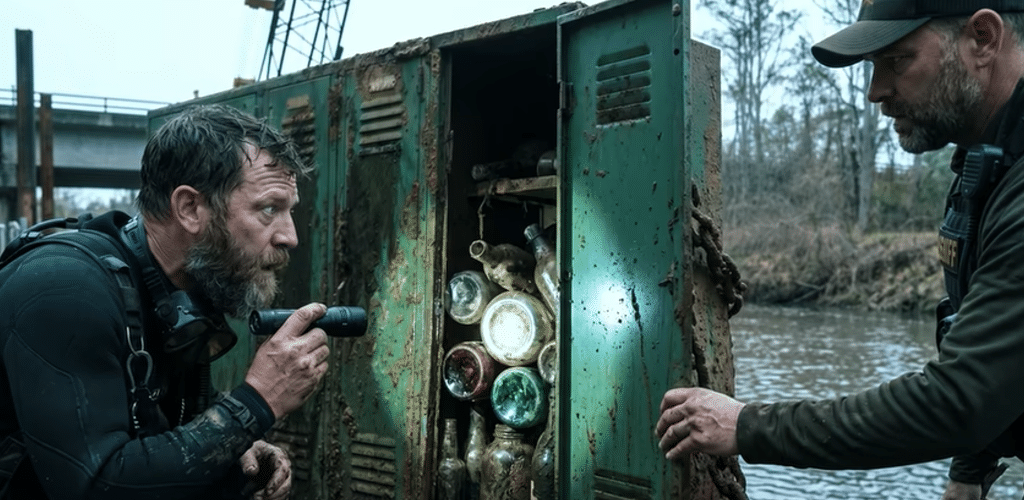
But an even stranger revelation awaited the investigators. When they cross-referenced the numbers on the canisters with the college’s archival catalogs, they found a discrepancy: three of the containers did not appear on any known list. Furthermore, the symbols marked on them did not match the labeling conventions used in official medical research.
Then, another chilling detail came to light. An inspection of the main padlock revealed that it had been secured peculiarly: the key had been left in the keyhole—on the inside of the unit.
Frank watched as personnel in protective suits packed the mysterious canisters into airtight containers. He had come to examine an old bridge, but instead, he helped unearth a piece of history that someone had seemingly gone to great lengths to bury in the swamp forever.
Now, the central question was no longer who had dumped the lockers into the river, but rather why three of the specimens had never existed on paper at all.
 Discuss
More news