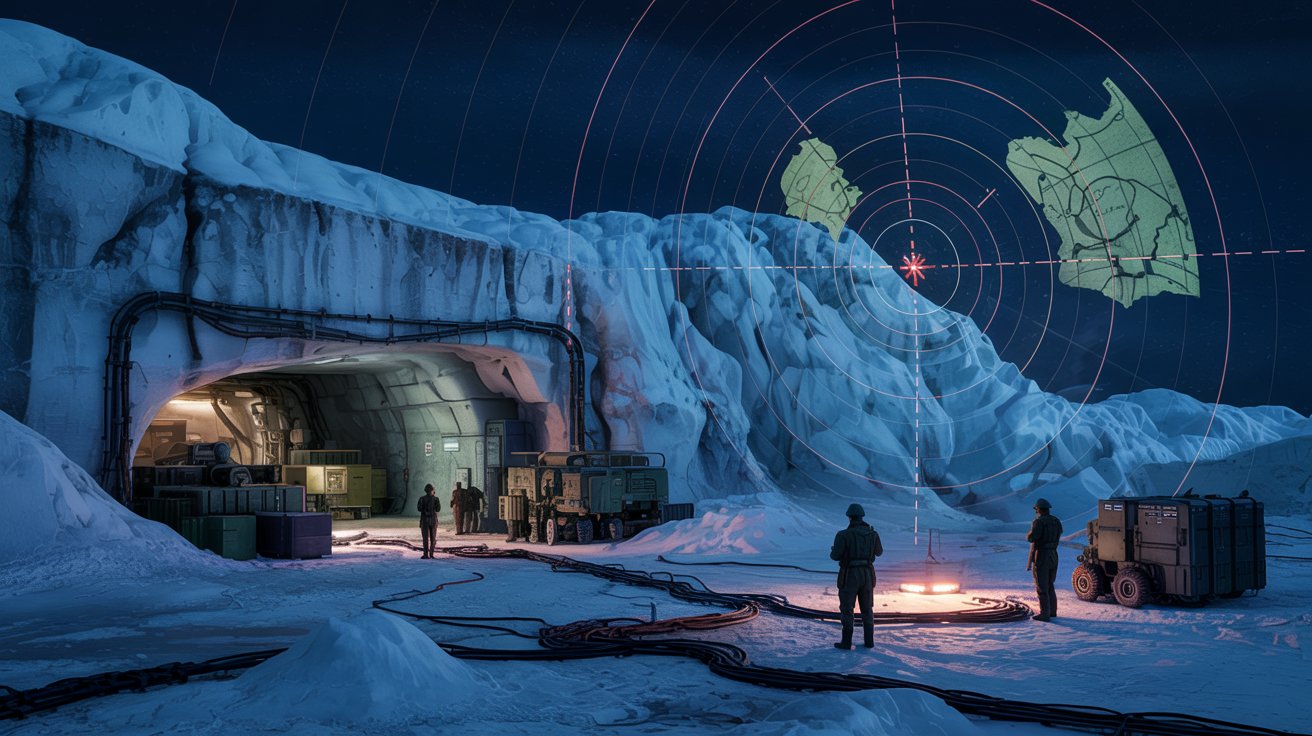
During a research mission over northern Greenland, NASA scientists made an unexpected discovery. Beneath a layer of ice approximately 30 meters thick, modern radars detected a network of artificial structures. Initially, specialists were unable to determine what exactly was hidden beneath the ice sheet, but further analysis revealed it to be a long-forgotten military base dating back to the Cold War.
NASA specialist Chad Green led the expedition. He and engineers flew a Gulfstream III aircraft equipped with a UAVSAR radar system. The mission’s primary objective was to study the interior structure of the Greenland Ice Sheet and test the capabilities of the new equipment. However, during scanning, the instruments unexpectedly revealed regular geometric shapes, clearly artificial.
Researchers later determined that the discovered structure was the famous Camp Century, a secret American complex built in 1959 by US Army engineers. At one time, it was called the “city under the ice,” as it was a veritable underground settlement with numerous tunnels, living quarters, laboratories, workshops, a power plant, and warehouses.
Officially, the construction of the facility was explained by the need to test new construction technologies in the extreme Arctic conditions and conduct scientific research. However, years later, it became known that the project’s true purpose was much more ambitious. The base was part of the secret Project Iceworm program, which envisioned the creation of a vast network of subglacial tunnels to accommodate ballistic missiles with nuclear warheads.
The military hoped to build an infrastructure covering an area of approximately 135,000 square kilometers—almost three times the size of modern-day Denmark. According to the plan, approximately 600 Iceman missiles and more than 2,000 launch sites were to be deployed under the ice. It was hoped that such a system would allow for rapid strikes against strategic targets in the Soviet Union and Eastern European countries.
However, this ambitious plan was never realized. After analyzing the technical difficulties, it became clear that the ice sheet was constantly shifting, making it virtually impossible to maintain the tunnels and launch pads. Consequently, the US military abandoned the project, and in 1967, Camp Century was permanently mothballed. All structures, equipment, and some waste remained in place.
Over the decades, snow and ice completely obscured the military facility. Buried under meters of ice, the base existed for a long time only in archival photographs and old maps.
According to the expedition members, they never expected to find the old base. Their goal was to study the glacier, but new radar data proved so clear that scientists were able to discern the locations of individual tunnels and structures hidden beneath the ice for nearly six decades.
Today, Camp Century is attracting the interest of not only historians but also climate scientists. Experts warn that, due to global warming, the Greenland ice sheet is gradually changing. Scientists estimate that by the end of the 21st century, the region could transition from constant snow accumulation to steady melting, making the release of ice-covered objects virtually inevitable.
 Discuss
More news
Discuss
More news