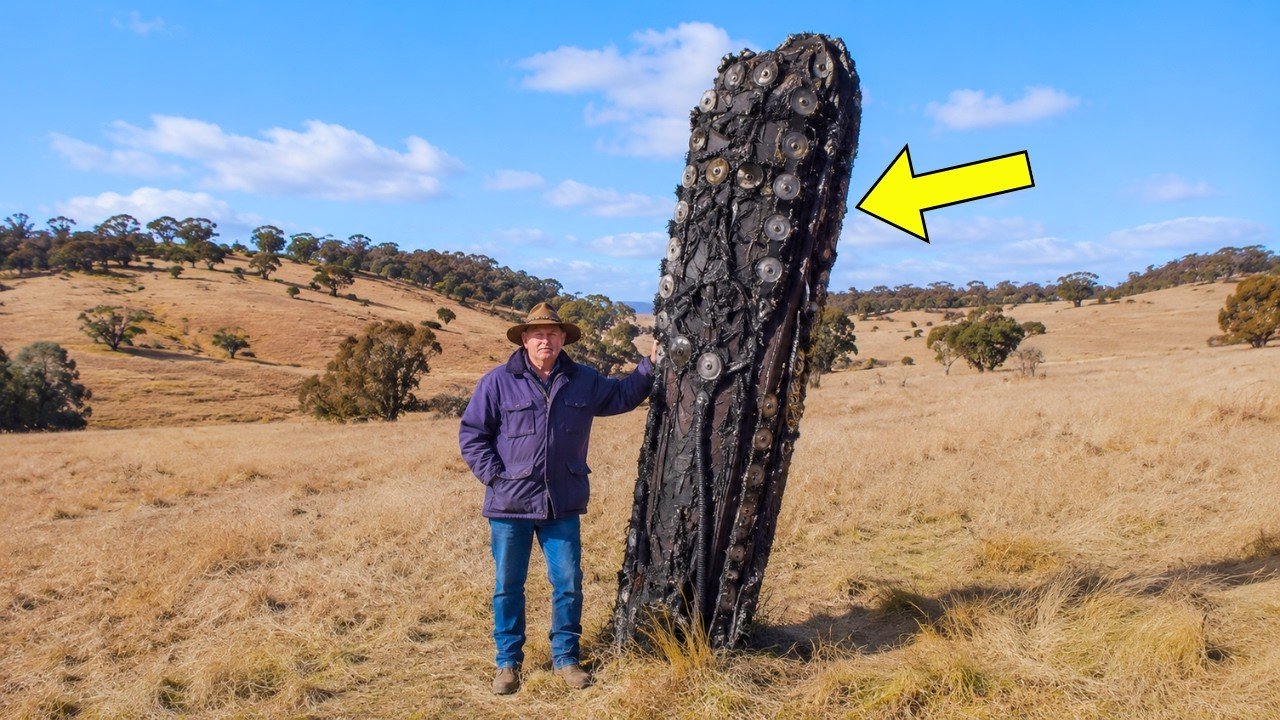
An ordinary morning on a sheep farm in the Australian state of New South Wales unexpectedly turned into a world-class event. While out on a patrol of his pastures, farmer Mick Miners noticed a tall, black object protruding from the ground in the distance.
At first, he thought it was a tree struck by lightning or someone’s discarded metal scraps. However, as he got closer, it became clear: this discovery was anything but ordinary trash.
In front of the farmer stood a structure about three meters tall, made of a black composite material. Its surface was charred and covered with layers of thermal insulation, and the distinctive smell of burning metal permeated the air. The object looked so unusual that it resembled a scene from a science fiction film.
Confused about what he had encountered, Mick called his neighbor, Jock Wallace. After examining the mysterious structure, Wallace advised him to contact the Australian aviation authorities immediately. After describing the discovery, the experts recommended taking an unexpected step – contacting NASA.
This advice surprised the farmers. They couldn’t have imagined that an ordinary day at the pasture would lead them to a conversation with representatives of the space industry.
Soon, the specialists recalled that a few weeks earlier, residents of southeastern Australia had heard a powerful sonic boom and observed a bright fire trail in the sky. At the time, it was believed that the space debris had completely burned up in the atmosphere. However, the discovered object proved otherwise.
Astrophysicist Brad Tucker obtained photographs of the structure from the Australian National University. After studying the images, he went to the discovery site. According to him, from a distance, the find did indeed resemble a charred tree trunk, but upon closer inspection, it became clear that it was a fragment of modern space technology.
The decisive clue was a serial number preserved on one of the panels. After inspection, specialists determined the part’s origin: it was a component of the SpaceX Dragon spacecraft, used in NASA’s crew delivery program to the International Space Station. During the spacecraft’s reentry, part of the structure separated, survived reentry, and fell onto the farm. Experts estimate that the object’s speed during its descent reached approximately 28,000 kilometers per hour.
The discovery sparked great interest among scientists, as such events are extremely rare. It turned out to be one of the largest spacecraft fragments discovered in Australia since the fall of parts of the Skylab station in 1979.
Experts also noted that the fragment’s landing in an uninhabited area was purely a matter of luck. Had its trajectory been offset by just a few kilometers, the consequences could have been much more serious.
According to international agreements, even after impact, such objects remain the property of the state or company that launched them. Therefore, the recovered fragment officially belonged to SpaceX.
The unusual space artifact was later placed on public display at the Australian Space Research Center.
 Discuss
More news
Discuss
More news