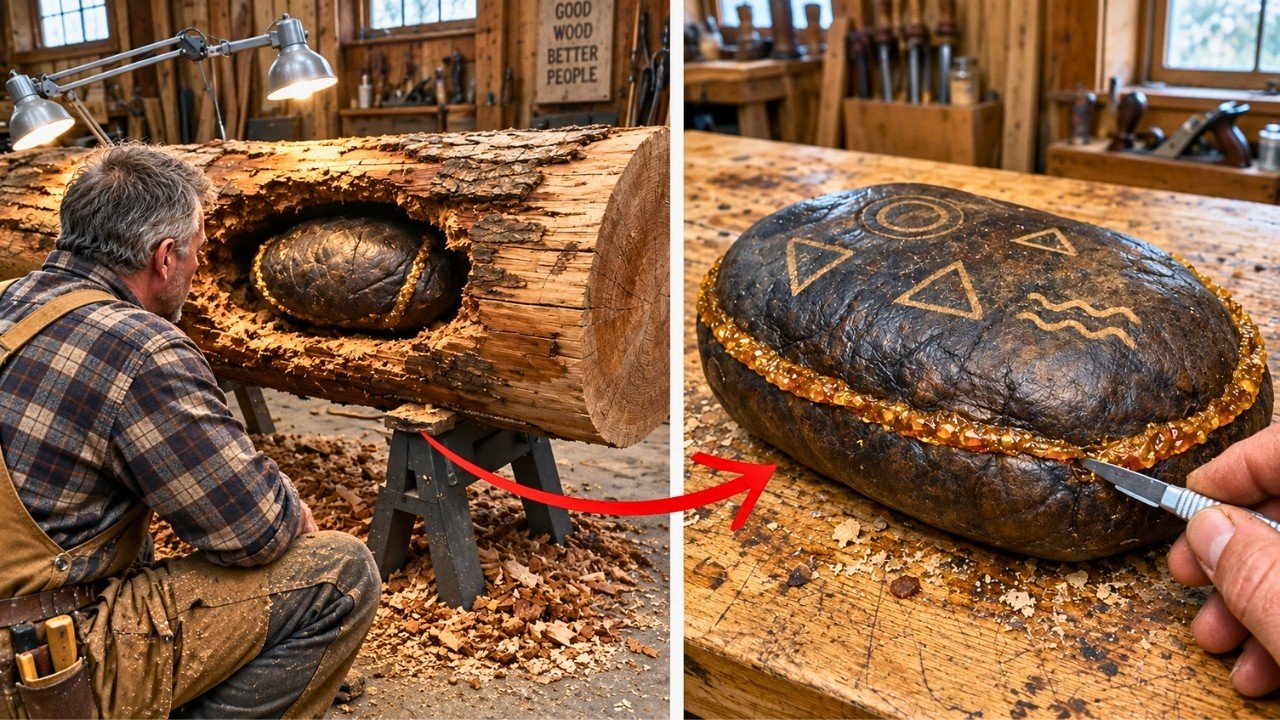
George Nielsen had been carving wood for decades, but one discovery completely changed his perspective on his craft.
One day, while working on a huge cedar trunk, his tool suddenly collapsed. George stopped and shone a flashlight into the hole. There was no rot or ordinary hollow inside. It contained an object, surrounded by wood.
The craftsman carefully widened the hole and soon extracted a heavy leather pouch. The leather had hardened with age, and its surface was covered with strange carved symbols. No name or other clues were found.
When George gently shook the find, something inside hit the wall hard. He assumed it might be ancient coins or hidden valuables.
Setting up a camera over his workbench, George began carefully peeling away the hardened layer that sealed the pouch. Beneath the leather, an additional wrapping was revealed. Inside lay a smooth, dark stone with an engraved symbol—a circle crossed by a cross.
George froze. He looked at the find, then at the tree trunk, imagining the person who had hidden this object inside the young cedar many years ago.
That’s when the craftsman began to cry.
The thought struck him that someone had entrusted a living tree with an important secret, hoping to return for it one day. But that never happened.
Realizing the possible historical value of the find, George contacted the museum. Experts asked him not to reveal any further details and invited representatives of the region’s indigenous communities.
A few days later, experts and elders gathered in the workshop. A study of the tree rings revealed that the cache had been created when the tree was young. Over the following centuries, the cedar had literally sealed the find within itself.
When the pouch was opened under the supervision of experts, several more skillfully carved stones were discovered inside. There was no gold or jewelry, but the significance of the find proved far more important. The symbols matched historical descriptions of ceremonial objects belonging to local indigenous peoples. Researchers hypothesized that the relics may have been hidden during times of conflict and displacement, when sacred objects were destroyed or confiscated.
The living cedar proved to be the perfect hiding place. As the tree grew, it gradually concealed the hidden objects beneath new layers of wood, preserving them for centuries.
One of the elders held the discovered stone in his hands for a long time.
George refused any reward and asked only that the relics be returned to the community to which they belonged.
A few days ago, he wept, imagining the man who hid the pouch and never returned.
Now everything has changed.
Centuries later, those to whom it truly belonged have finally come forward to claim this secret.
 Discuss
More news
Discuss
More news