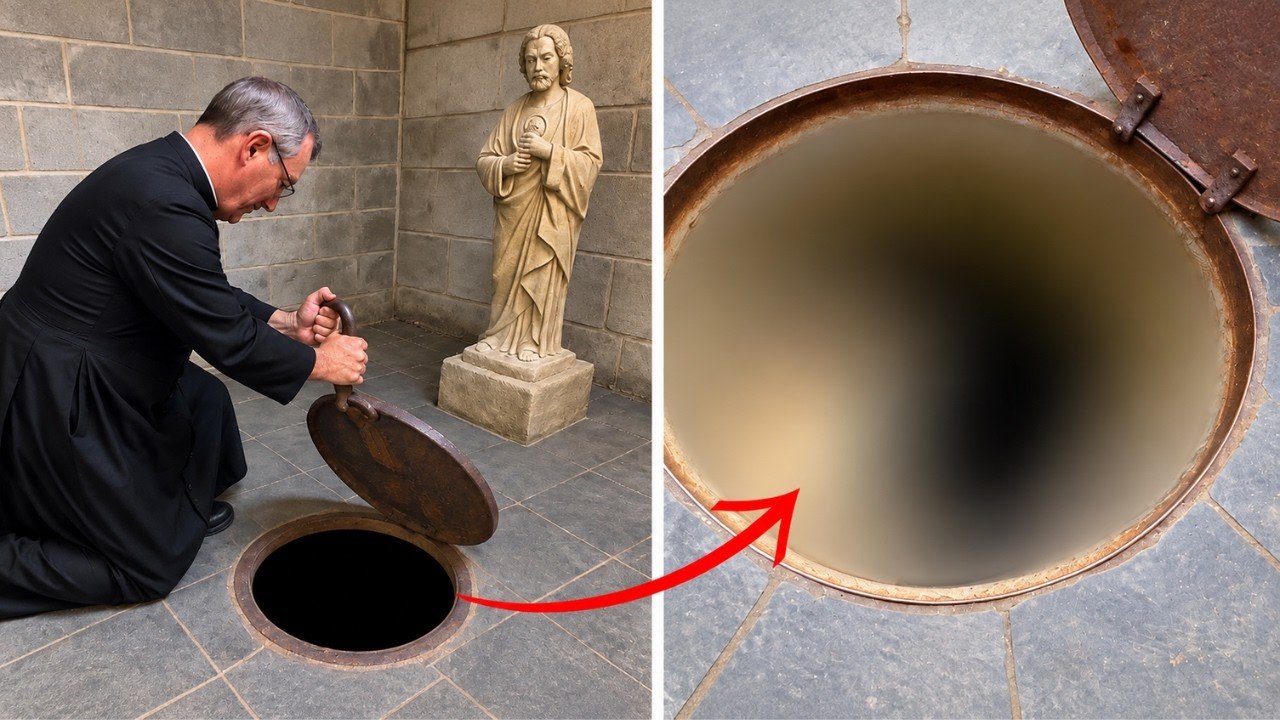
When Father Thomas began renovations near the old church’s side chapel, he expected only the usual signs of age. But after workers moved a heavy statue of Saint Jude, they revealed a stone slab with a rusty ring beneath its base.
The slab covered the entrance to an underground chamber.
Beneath it lay a narrow staircase leading deep underground. Yet neither church archives nor old building plans recorded the space’s existence.
Accompanied by historian Dr. Karl Sanders, the priest descended into the tunnel. The stonework proved to be significantly older than the church itself; crosses, symbols, and numerous notches were visible on the walls.
Soon, the passageway ended at a brick wall.
It had clearly been built long after the surrounding masonry. Above an archway, the researchers spotted a nearly worn-away Latin inscription:
“NON APPER… PESTIS — 1665”
— “Do not open. Plague. 1665.”
Archival research made the discovery even more mysterious. The church register from 1665 had survived almost intact, yet the pages covering the middle of that year had been torn out.
To understand what lay behind the wall, specialists drilled a small hole and inserted a fiber-optic camera.
At first, the screen showed the remains of wooden structures and rotted fabric. Then, the camera illuminated something no one expected to see: human skulls and bones.
After carefully dismantling the wall, archaeologists discovered dozens of skeletons. The deceased included both adults and children.
But the most harrowing discovery awaited them on the masonry itself.
Hundreds of scratches, notches, and short messages remained on the inner side of the bricks. Among them was the phrase “Miserere Nobis”—”Have mercy on us.” Some traces ran along the mortar joints between the bricks. This served as grim proof: people had been inside when the passageway was sealed off.
Documents discovered later shed light on what had happened. During the plague epidemic of 1665, the underground chamber was used to isolate the sick. As fear of the infection gripped the settlement, church authorities ordered the space walled off.
The people were left inside.
The surnames found in the surviving records matched those of families still living in the town today. For years, their ancestors had been told that these relatives had vanished or been buried in mass graves.
After 350 years, the mystery was finally solved. The town held a memorial service, and for the first time, the names of those whose fates had been deliberately erased from history were spoken aloud.
Yet the brick wall could not hide the most important thing. The voices of those trapped behind it have reached us across three and a half centuries.
 Discuss
More news
Discuss
More news